Lionel Messi Through a Bayern Fan's Eyes: From Genius to Legend
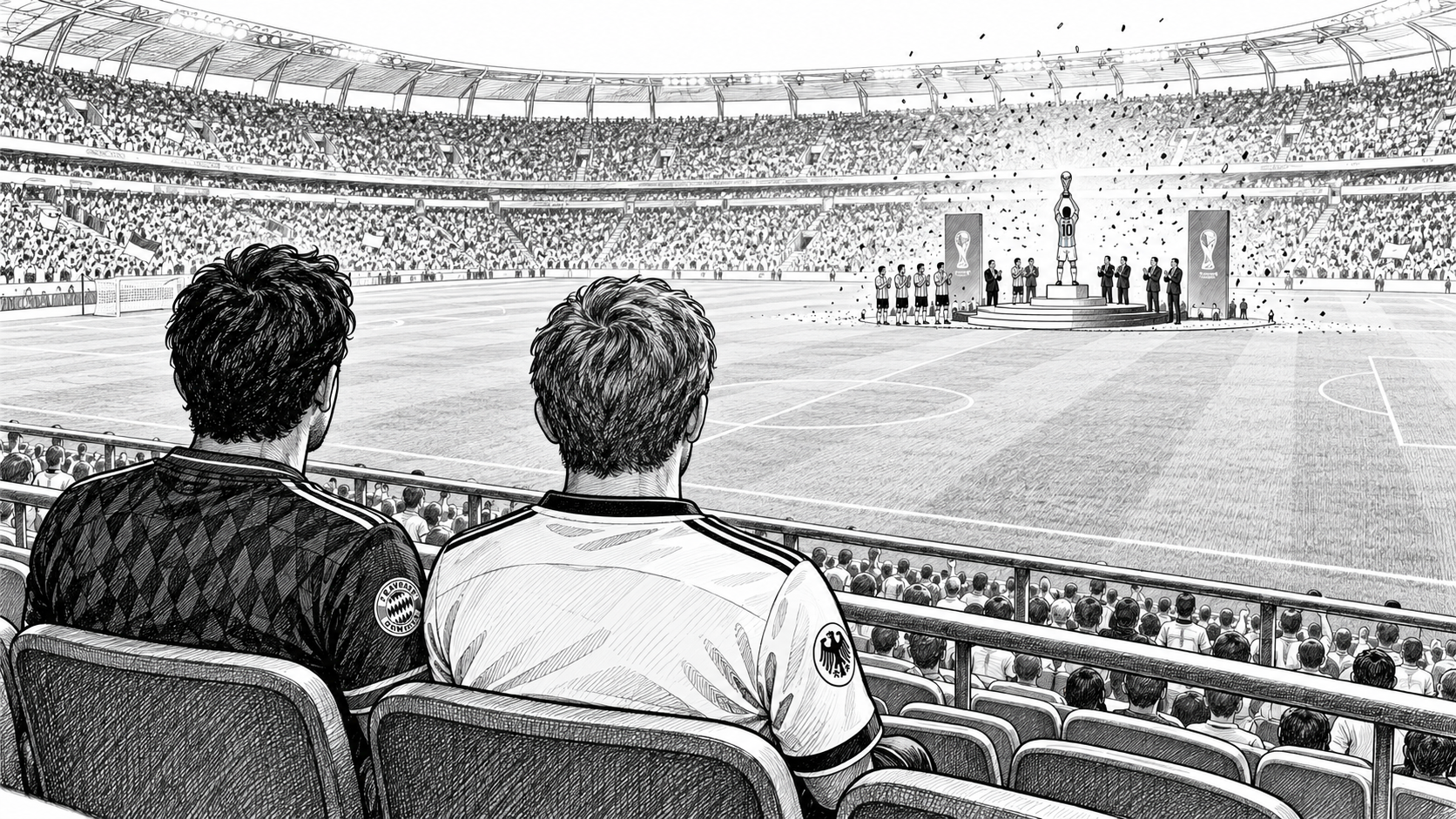
I'm a die-hard Bayern Munich and Germany fan. My footballing life began with the three heartbroken glances Michael Ballack gave in 2002, and since then the German national team and Bayern Munich have been everything to me. Over these twenty-plus years, our path kept crossing that of an Argentine genius, and I had a front-row seat to his rebirth from prodigy to legend — including the moments every football fan loves to retell: the little note in Berlin, the 0-4 in Cape Town, the "7-UP" at Camp Nou, the "82 Lafite" in Lisbon, the dagger at Camp Nou, and the triple block at the Allianz.
Station 1 · June 30, 2006, Berlin: Germany Won, but We Never Saw Him
In October 2004, an Argentine teenager with growth hormone deficiency — able to grow to 1.69 meters only because a Spanish club paid for his treatment — came off the bench at Camp Nou to make his La Liga debut. At seventeen, he was already the wonderkid in every headline.
Two years later at the World Cup, we shared a pitch with him for the first time — yet never truly faced him. By then he already had the 2005 FIFA World Youth Championship title, the Golden Ball and the Golden Boot, plus back-to-back La Liga crowns and a Champions League with Barcelona. But in that quarter-final in Berlin: Ayala scored first, Klose headed an 80th-minute equalizer, and after 120 minutes it was 1-1. The whole world waited for Argentina to bring on the genius to change the game. Pekerman never did. Messi spent the entire match on the bench, and Germany advanced 4-2 on penalties.
Germany won. But everything was just beginning.
Station 2 · April 8, 2009, Camp Nou: The First Time We Understood — This Was a Genius in a Genius Team
When the 2008-09 Champions League quarter-final draw handed us Barcelona, we had Ribéry, Klose and Toni — a squad afraid of no one. Yet after just 90 minutes at Camp Nou it was 4-0, and the tie was already over. He scored twice, at his dazzling best. What crushed us wasn't only the scoreline but the sheer beauty of what he orchestrated: fluid, irresistible, yet utterly in control. That year he and Barcelona won the first-ever sextuple.
Station 3 · July 3, 2010, Cape Town: Our Textbook Team Performance — and the Controversy It Started
But let's go back to the national team. His Barcelona success never carried over to Argentina.
At that World Cup in South Africa, he teamed up with Maradona, and in the quarter-final Löw's young German side delivered a masterpiece.
Thomas Müller headed us in front after three minutes, Klose struck twice, Friedrich added one more, and it finished 4-0. Germany turned team football into a textbook, cutting off every line between Messi and Argentina's box, and the most hyped player of the tournament finished without a single goal. There was also the yellow card that day that ruled Müller out of the semi-final — for many of us, one more reason to resent Messi.
From then on, people said that away from Barcelona — away from Xavi, Iniesta and Busquets — he was nothing.
Station 4 · May 1, 2013, Camp Nou: The "7-UP" Night — He Became a Backdrop to Our Party
The 2012-13 Champions League semi-final ended 7-0 on aggregate. We had already celebrated after the 4-0 in Munich — two goals from Müller, plus Gomez and Robben; a week later at Camp Nou, Robben, a Piqué own goal and a Müller header twisted the knife, 0-3, and all of Germany was talking about the treble. Messi, playing through a thigh injury, was a shadow of himself: in the starting XI for the first leg and invisible all night; for the return, fit only for the bench, sent on at half-time without a single dribble of note.
That was the peak of "Old Bai and the Sea": that season Heynckes swept the Champions League, the Bundesliga and the German Cup. Bayern fans raised their glasses; he was, once again, a background figure.
Station 5 · July 13, 2014, Maracanã: He Did Everything Right — but He Still Wasn't Maradona
For a Bayern fan, this was probably the night of our lives. Messi at 27 — body, experience and mind all at their peak — against Löw's Germany. Götze replaced Klose in the 88th minute; in the 113th, Schürrle burst down the left and crossed, Götze chested it down and volleyed home — 1-0. Germany lifted the World Cup for the fourth time, drawing level with Italy.
At the final whistle, Messi walked past the World Cup trophy, his eyes brushing it without touching — and the photographer behind him captured the image that went around the world. He took the Golden Ball with four goals and an assist, but competitive sports only offer consolation to the defeated.
Without the trophy, nothing else meant anything.
For Bayern fans, it was pure jubilation; for him, it was the cruelest threshold between genius and legend. Back then, I didn't believe he would ever cross it.
Station 6 · May 6, 2015, Camp Nou: A Quintuple-Winning Revenge — Proof That It Was Still His Era
Ten months later, we met again in the Champions League semi-finals. For the first 76 minutes at Camp Nou, Boateng and his fellow defenders kept Messi virtually invisible — then in the 77th he cut in from the right and drilled low into the far corner. In the 80th came the goal that would be replayed for a decade: a little feint on the edge of the box sent Boateng's center of gravity collapsing, the defender toppling sideways behind him, and before the defense could recover Messi arced a left-footed chip over Neuer into the far corner. Neymar sealed 3-0 in stoppage time. In the return leg we won 3-2 — losing the era, but winning a match.
Barcelona lifted the treble that year. What I remember is this: the man we had swept out 7-0 took his revenge in the most unreasonable way imaginable, and then told us — this is still his era.
Station 7 · August 14, 2020, Lisbon: After the "82 Lafite", His Club Era Went Into Countdown
From 2015 to 2019, Barcelona, Bayern, Germany and Argentina were all in decline: Barcelona blew Champions League leads to Roma and Liverpool in consecutive years, Bayern were knocked out by Real Madrid and Liverpool, defending champions Germany made their record early exit in the 2018 group stage, and Argentina fell in two straight Copa América finals.
Then fate handed rock-bottom Bayern a man named Flick (yes, Barcelona's current head coach), and set up a meeting between the two FCB clubs in Lisbon that August.
What followed was the infamous 8-2: Müller scored twice and won the official Man of the Match award, Perišić, Gnabry, Kimmich and Lewandowski added the rest, and Coutinho — the very Coutinho Barcelona had loaned to Bayern the season before — came off the bench for two goals and an assist to nail his parent club at 8-2. Alaba even "helpfully" contributed an own goal. That Flick Bayern then swept everything, winning an unprecedented sextuple.
For Messi, the 8-2 was the final straw for Camp Nou: that summer he handed in a transfer request and failed to leave; a year later, in August 2021, Barcelona's financial collapse meant they could no longer keep him, and off he went to Paris, France.
Station 8 · December 18, 2022, Lusail: Still Adrift, We Witnessed the Night of His National-Team Rebirth
In the winter of 2022 I watched the final with deeply mixed feelings (and, that year, with COVID).
Argentina against France — two teams we had beaten in 2014. They were about to contest the biggest match on earth, while we had failed to escape the group stage for a second straight tournament. I still don't know why even Flick couldn't rescue that Germany side. For Bayern fans, seeing Upamecano and Coman feature in the final was at least something amid the bitterness.
The final delivered the most dramatic 120 minutes in World Cup history: 3-3, Messi with a goal from open play and one from the spot, Mbappé with a hat-trick. Then 4-2 on penalties.
When the golden confetti rained down and Messi raised the World Cup with both hands, 36 years of waiting and four lost finals — in that moment, the door between genius and legend was finally battered open.
Station 9 · March 8, 2023, Allianz Arena: We Were Fortunate to Become a Footnote to His Last European Night
In Paris, he went back to No. 30 — the number from his Barcelona debut; Neymar offered the No. 10 and he declined. Around him were former teammates from the quintuple-winning side, Mbappé — the breakout star of the 2018 World Cup — and the wealth of Paris's oil empire. Yet he couldn't take them further in the Champions League: knocked out after a comeback at the Bernabéu in year one; in year two, the draw sent us to meet them.
The 2022-23 Champions League round of 16 came less than two months after his crowning in Lusail, against that old 8-2 rival. Bayern won 3-0 on aggregate. A bit of trivia: Müller has six goals in five Champions League games against Barcelona — more than any other player in the competition's history.
It was the third time Bayern had knocked him out of the Champions League: 2013, 2020, and now 2023. Nobody realized at the time that it was also the last 90 minutes of his European career — after that summer, Europe never saw him again. From Camp Nou to the Allianz, seventeen years: his final European night was left to us.
Station 10 · 2026, New Jersey: We Watched Him Finally Surpass Maradona
Everyone thought the story ended in Qatar. Messi disagreed.
In the summer of 2026, at 39, he played his sixth World Cup. On June 17, in the group-stage opener against Algeria, he started and struck a perfect hat-trick — at 38 years and 357 days, the oldest hat-trick scorer in World Cup history — and became the first player ever to appear at six World Cups: the previous mark for a men's player stood at five, and even Cristiano Ronaldo had to wait another 14 hours to match the feat. That night was also his 200th cap for Argentina, with 16 World Cup goals drawing him level with Klose. He then carried Argentina past Egypt, then England, all the way to the final, where at MetLife Stadium in New Jersey they fell 1-0 after 120 minutes to Lamine Yamal and his Spain.
Personally he scored 8 and assisted 4, closing his World Cup career at 34 matches, 21 goals and 12 assists: only Mbappé, with 22, has more goals, and his 12 assists are the most in World Cup history.
In my eyes, he was the only candidate for that tournament's Golden Ball. He has surpassed Maradona. But more moving than the surpassing is the following: back then, the frail little boy from Rosario fell in love with football by following Maradona's footsteps. From now on, countless Argentine kids will pull on his No. 10, chase him the way he once chased Maradona, and keep telling the story of Argentine football.
Epilogue: He Gave Everything to the National Team, Won Everything — and It Was Time to Say Goodbye
On August 31, 2026, Messi published his farewell letter to Argentina. He had written it on July 21, two days after the final; by the time it was made public, his father Jorge had been gone for just eight days, and the letter carried a weight almost too heavy to bear:
"I gave everything. There really is nothing left to give. Thank God for making me Argentine. Vamos, Argentina!"
On October 6, at the Monumental, a friendly against Benin became the last time he would wear the sky-blue and white. He arrived at eighteen and said goodbye at thirty-nine — twenty-one years in the blink of an eye, and we were lucky enough to watch a natural-born prodigy walk, step by determined step, into a football legend.